Explore the Bible: April 12
Eternal Life • Matthew 19:16-30
By Joe McKeever
We call the man the “rich young ruler” for good reason. Mark called him rich (9:22), Matthew called him young (19:20) and Luke said he was a ruler (18:18).
Immediately before this encounter, we have our Lord’s interaction with the little children (19:13-15) when Jesus said, “The Kingdom of Heaven belongs to such as these” (NASB). We have to wonder whether the rich young ruler was in contrast with childlikeness or an illustration of it in some ways.
First. Matthew 19:16. The excellent quest and the interesting question. “Someone came to Him and said, ‘Teacher, what good thing shall I do that I may obtain eternal life?” (NASB).
The man wants eternal life. That’s good. We wonder what exactly he had in mind. Was he thinking of Heaven? Of forgiveness of sins and salvation as we understand it? Or simply of never dying? There is no way of knowing.
But he thinks it’s achieved by some outstanding work. That sounds just like outsiders, doesn’t it? This kind of thinking Paul calls “the natural man” (see First Corinthians 2:14). Surely, such a person thinks, the way to Heaven’s blessings is by good works. Climb higher. Work harder. Give more. You’ll get to heaven.
But Christ’s way is a different way entirely (See Isaiah 55:8-9). It’s not do but done. Not by doing something amazing (see Micah 6:6-7), but by putting faith in our amazing Savior. Not by works, but by grace (Ephesians 2:8-9).
Second. Matthew 19:17. Jesus’ surprising response. “And He said to him, ‘Why are you asking me about what is good? There is only One who is good; but if you wish to enter into life, keep the commandments.”
Our Lord’s answer is of two parts: a rebuke prompted by the young man’s “good thing” question, and a response more along the lines of what the young man was looking for. Jesus needs him to see the impossibility of keeping that Law. Before the man can get saved, our Lord has to get him lost. This is the purpose of the Law. “I would not have known sin except for the Law…and for that reason, the Law is holy…” (Romans 7:7,12 my paraphrase).
(Note: We should never miss that after the Lord gives us the Ten Commandments in Exodus 20, it’s followed immediately with provisions for an altar in 20:24-25. The Commandments are His perfect standard, but He knew we would not be able to keep them and would need forgiveness, which is available only at Calvary.)
When the youth responds, “All these things I kept from my youth,” Mark says Jesus loved him (Mark 10:21). Perhaps our Lord saw a childlikeness about him. A naivete, if you will. His problem — and he did have them — was not pride.
Third. Matthew 19:21. Jesus puts His finger on the problem. “Jesus said to him, ‘If you wish to be complete, go and sell your possessions and give to the poor, and you will have treasure in heaven; and come, follow Me.”
Ah, that did it.
The way to Heaven, of course, is not by giving away your riches. But the Lord’s instructions identified the barrier to the man’s faith: he did not own his possessions; they owned him. He would need to break their stranglehold.
I’m remembering a friend who came to Christ in his mid-forties. At one point he struggled with whether God was calling him into the ministry. Eventually, when he surrendered, the Lord said, “I do not want you in the ministry, but I wanted you to be willing.”
Fourth. Matthew 19:22. The Lord lets him walk away. “But when the young man heard this statement, he went away grieving; for he was one who owned much property.”
I can recall witness training from years ago in which we were taught never to let a potential convert walk away. We must attack their excuses. “Win or warn” we were instructed.
But our Lord let the man walk away.
In John 6, when Jesus was teaching His followers about the deeper things of the faith, many resisted. One by one, they walked away. “As a result of this many of His disciples withdrew and were not walking with Him anymore” (John 6:66 NASB).
He let them go.
Leaving was their choice.
Jesus pays us the ultimate compliment: He lets us choose where and how we will spend eternity.
Our Lord forces His blessings on no one. He lets us choose. Weeping over Jerusalem, Jesus said, “…how often I wanted to gather your children together as a hen gathers her chicks under her wings, and you were unwilling….” (23:37 NASB). Leaving was their choice.
In Revelation 3:20, our Lord told the church at Laodicea, “Behold, I stand at the door and knock; if anyone hears my voice and opens the door, I will come in to him and will dine with him and he with Me.”
Don’t miss this: our Lord brings the blessings of Heaven right up to the door, but no further. He knocks and asks for admittance.
Our Lord Jesus does not force Heaven’s blessings on anyone.
We get to choose. We have to choose.
We hope the rich young ruler changed his mind later and got this right.
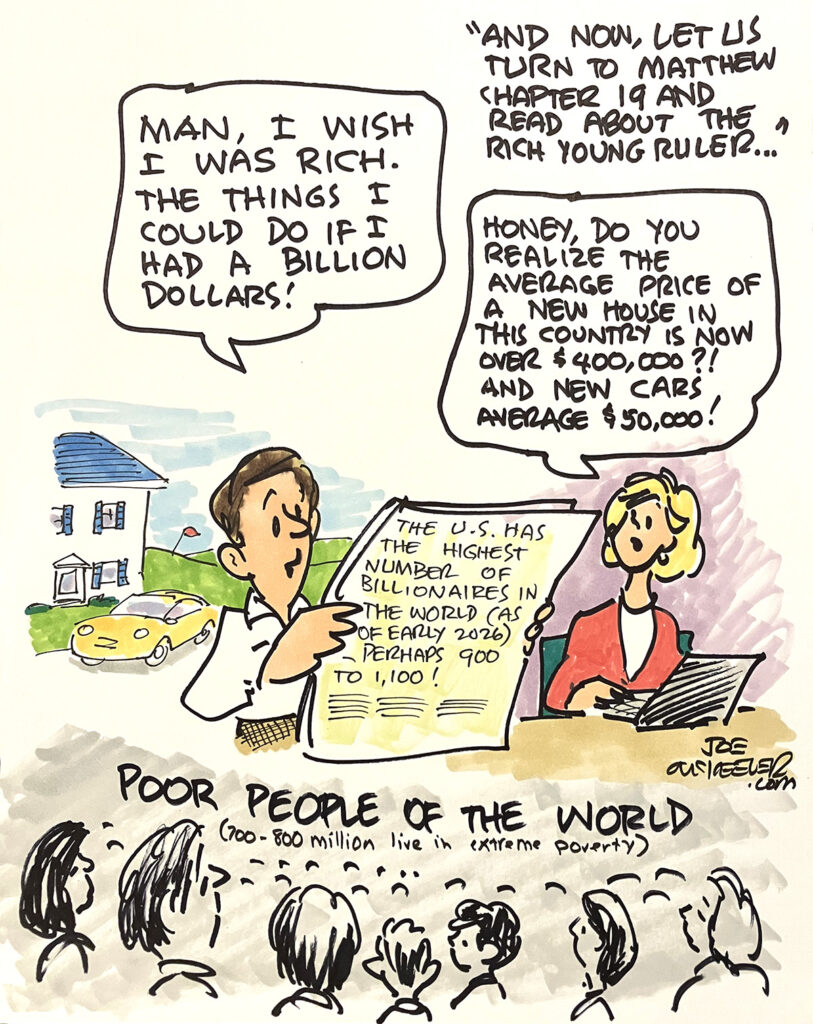
Finally, we who live in the most affluent nation on the planet must not read this as though we’re talking about other people. You and I are rich. If you are able to buy groceries without wondering whether there is enough money in the bank to cover it, you are rich. Now, I suggest you go back and read this story, except this time you are the rich young ruler being told to give all your wealth to the poor and follow Jesus. How is that looking for you?
McKeever is a member of First Baptist Church, Jackson.