Explore the Bible: May 24
Our atonement • Matthew 26:17-30
By Joe McKeever
Finally, we have arrived at the primary theme of all Scripture: Our Savior is giving His life for us. It was the theme of the Old Testament scripture — all through the teachings (beginning at Genesis 3:15!) and prophecies (see Isaiah 53) and the symbolisms/types (see Numbers 21:6-9), everything pointed ahead to Calvary. And now, after our Lord’s three years of ministry, we come to the climax of His Mission to Planet Earth.
Our Lord Jesus was going to die for our sins.
He felt He needed to emphasize: “No one is taking my life from me. It’s my own decision. I’m laying it down of my own accord (John 10:18 my paraphrase). He said, “For this purpose I came to this hour” (John 12:27 NASB).
Our Lord came to die. Revelation 13:8 calls Him “the Lamb slain from the foundation of the world” (KJV).
Throughout the Old Testament days, every Israeli altar pointed ahead to this act. When Moses was preparing the Israelites to leave Egypt, they sprinkled the blood of the Passover Lamb on the doorposts of each home (Exodus 12). Those lambs shed their blood to save God’s people. And now, “Christ our Passover also has been sacrificed” (First Corinthians 5:7).
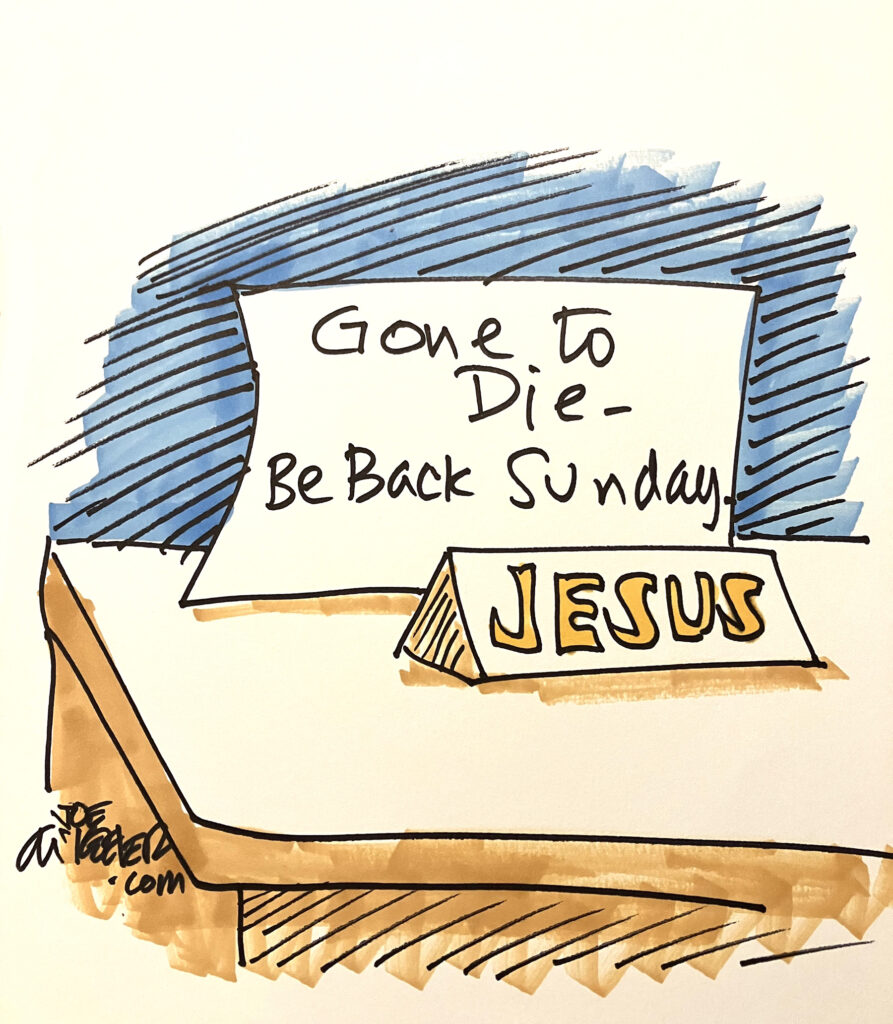
A Gospel song puts it this way: But don’t feel sorry for my Jesus; He did exactly what He came to do.
Now, we should make this point: Satan did not understand this. First Corinthians 2:8 points out that if the rulers of this age had understood what God was up to, they would not have crucified the Lord of glory (NASB).
Today’s focal passage (Matthew 26:17-30) covers the preparation of the Passover, the eating of the Passover meal, and the Lord’s Supper, which incorporated the message of the Gospel with the Passover. All of this was spiritual preparation for the disciples, not for Jesus. He knew, but they didn’t. So, He was preparing them for the event and what to make of this event for all time to come.
These preparations, we say, were for you and me, so we would know what to make of Jesus’ death (and of course, His burial and resurrection).
Scripture teaches:
1) Jesus’ death was God’s plan from the beginning.
2) None of it took Jesus by surprise. Repeatedly He said, “My hour has not yet come” and then eventually, “My hour has come” (see Mark 14:41 and Matthew 26:2).
3) We should not think He took it lightly, however. In Gethsemane, Jesus literally sweat drops of blood (see Luke 22:44), which speaks of the inner agony He was experiencing.
4) In the Lord’s Supper, Jesus said, “This is my body and my blood” (see Matthew 26:26, 28 and First Corinthians 11:24-25). (We will let others debate to what extent this becomes the literal flesh and blood of our Savior.)
5) Before leaving the Upper Room for Gethsemane, we read: “After singing a hymn, they went out to the Mount of Olives” (26:30). Do you wonder what was the hymn? Scholars agree it was Psalm 118. May I suggest you go back and read that wonderful psalm with the Upper Room scene in mind? And don’t rush past verses 22-24, the heart of the psalm.
— Verse 22: The stone which the builders rejected has become the chief cornerstone. See Acts 4:11 and First Peter 2:7.
— Verse 23: This is the Lord’s doing and it is marvelous in our eyes. On the surface, it looked like Satan had pulled off a major victory. But he was to find out differently. God did this!
— Verse 24: This is the day which the Lord has made; let us rejoice and be glad in it. How many times have you heard this verse quoted, usually out of context. It actually refers to our Lord’s rejection followed by His elevation as the chief cornerstone. (But even so, applying this verse to every day of our lives is still a great idea!)
Bryan Harris was our student minister at First Baptist Church, Columbus. Since Bryan spoke Spanish, he loved to take our people on mission trips. Once, on a trip into Argentina, in the market place he came upon a craftsman carving mate’ cups. The customer could choose a block of wood which the man would then carve into a cup. But Bryan reached into a bucket of rejects, selected a flawed block and handed it to the man. “Oh no, señor,” the man said. “Those are not good ones. Choose from these.” But Bryan insisted and the man went to work on the less-than-perfect piece of wood. While he worked, Bryan talked about the Savior who was rejected but became the Chief Cornerstone. As the man finished the cup, they prayed together and the man received Jesus as his Savior.
Have you received Jesus? Your salvation was the whole point of His coming into this world!
McKeever is a member of First Baptist Church, Jackson.