Years of praying, serving finally yield fruit for IMB workers
Editor’s note: Names have been changed for safety reasons.
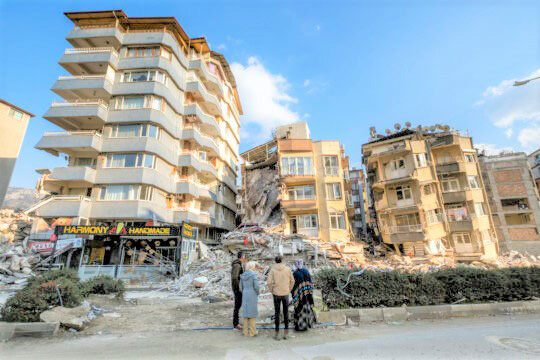
DAMASCUS, Syria (Baptist Press and local reports) — For Syrians, the world has been crumbling for years. This February’s deadly earthquakes have only added mounds to the existing literal and figurative rubble of a nation already torn apart by the internal strife of civil war.
“The people of Syria have been so broken by war and the desperate situation there for over a decade now. This just compounded on an already desperate situation,” said Raleigh Clements, who has served with Southern Baptists’ International Mission Board (IMB) for 13 years.
The death toll stands at 50,000 and is expected to climb. Clements estimates around 500,000 Syrians have been displaced because of the earthquakes.
Evie Tucker, who also serves with IMB, said many Syrians believe the earthquakes — two in one hour followed by numerable aftershocks — have been worse than the war. Syrians knew the war was coming and while they didn’t have long to prepare, most had the option of deciding whether to stay or leave and could take some of their possessions.
The earthquakes struck with no warning in the middle of the night. Tucker said men, women, and children poured out of apartment buildings in their pajamas in the driving rain. Many, if not most, had to flee their homes without their ID cards.
Tucker said her Syrian refugee friends face hopelessness. Some have already been displaced for 10 years due to the civil war and struggle to build a life for themselves. The thought of having to start over yet again is daunting.
Syrians who live in cities farther away from the earthquake’s epicenter have welcomed family members who had to relocate. Receiving their family members was emotionally difficult.
“You’ve got traumatized people receiving traumatized people, and everybody is being re-traumatized,” Tucker said. “How much more can these people take?”
In Syria, which lacks developed infrastructure in most of the affected area and machinery that can be used in the earthquake response, many people dig through the rubble with their bare hands — the concrete, glass, and debris wedging under their fingernails.
Political sanctions also complicate relief efforts as well as bans on U.S. dollars in the country.
An estimated four million Syrians live in Turkey, where the earthquakes near the border with Syria toppled buildings and claimed lives. Devastation in Turkey was extensive, but more international relief organizations are responding.
The ease of entry into Turkey and the developed infrastructure there makes recovery and relief efforts much easier for international relief organizations. In Syria, this has not been the case. Send Relief, the compassion ministry jointly supported by IMB and Southern Baptists’ North American Mission Board and made possible through the generosity of Southern Baptists, is mobilized across the affected area.
In addition to meeting physical needs, Clements hopes to institute a long-term mental health program that will help people cope with their trauma and work through the suffering they’ve experienced. The hope is for Christians in Syria to receive training online or by traveling to a more open country.
Around 300,000 Syrian refugees live in the area where the Clements couple lives. This statistic reflects pre-war numbers. The couple has an active ministry among the refugees, and they’re looking to employ similar strategies in the earthquake area using those existing connections.
Raleigh Clements met with Syrian Christians when he visited a city devastated by the earthquakes. Shock was still written on everyone’s faces, but testimonies of God’s faithfulness were written on their hearts.
Tucker said a visit to the region reminded her of a war zone. She’s from Tennessee and is accustomed to the destruction tornadoes bring, but she was moved by the massive swath of destruction that extends far past the radius of a traditional tornado.
She walked to her favorite coffee shop and found it in shambles. The falafel shop she had enjoyed before is gone. She visited one city where 80% of the buildings will have to be leveled and rebuilt.
“What is the thing that the Lord is wanting to see happen among Syrians and how is He asking us to be a part of that?” Tucker is asking herself.
Tucker has made several trips to a heavily hit region to assess and meet needs. One of the trips was with a Send Relief team, and another with a Southern Baptist Disaster Relief team. Her team works with national believers and local churches to support families and communities affected by the earthquake.
The aid comes in a variety of forms, including supplying food and tents and hosting volunteer teams that provide medical assessment and water filtration systems. Her local partner is investing in remote villages that haven’t received much aid. The population of one of these villages is predominantly widows and their children.
Tucker said she and other Christians have had more meaningful spiritual conversations at a faster rate than usual.
Many of their conversations are punctuated by questions: “Why do you think God let this earthquake happen?” and “Is God punishing people?” and “Is He angry?” and “There are so many people who didn’t know the Lord before they died. Why did God let that happen?”
Tucker anticipates questions like that, and as they continue to follow up on the new relationships they will move into deeper conversations.
Tucker met an elderly woman staying in a tent in the courtyard of a church. She lost her husband in the earthquake. Her children live abroad, and since she has no paperwork or ID she is unable to travel to them for help.
The woman was afraid to sleep because she feared there might be another aftershock. Full of emotion, she told Tucker she felt alone. Tucker shared how God promises He will never leave nor forsake her and He loves her and sees her, even though she feels alone.
The women prayed together and the woman left feeling encouraged.
Tucker said her team is experiencing a Gideon-like season. In chapter seven of the Old Testament Book of Judges, God instructed Gideon to reduce the number of men in his army so they would have to depend on Him for victory.
“Our team has gotten really small in this season where the work around us is almost limitless, and so that has been a real testing point for our team to trust the Lord,” Tucker said.
The reduction in her team numbers has led to a deeper partnership with local believers. She’s cried out to the Lord, saying, “You knew that this earthquake was going to happen, and You knew that our team is going be the size that it is right now.”
The night before the earthquake, Tucker re-read through a Bible study for a leadership training program. She read a section encouraging the reader to “pray to the Lord, ask Him to show you where He’s working and where He’s calling you to join Him in the work.”
The next morning, she received word of the earthquake. While what she has experienced since then has been overwhelming, that assurance from the Lord has helped carry her through.
She knows God has her exactly where He wants her. Her desire is that her team would serve Him and share hope and truth to those who are hurting and in need of a Savior.