
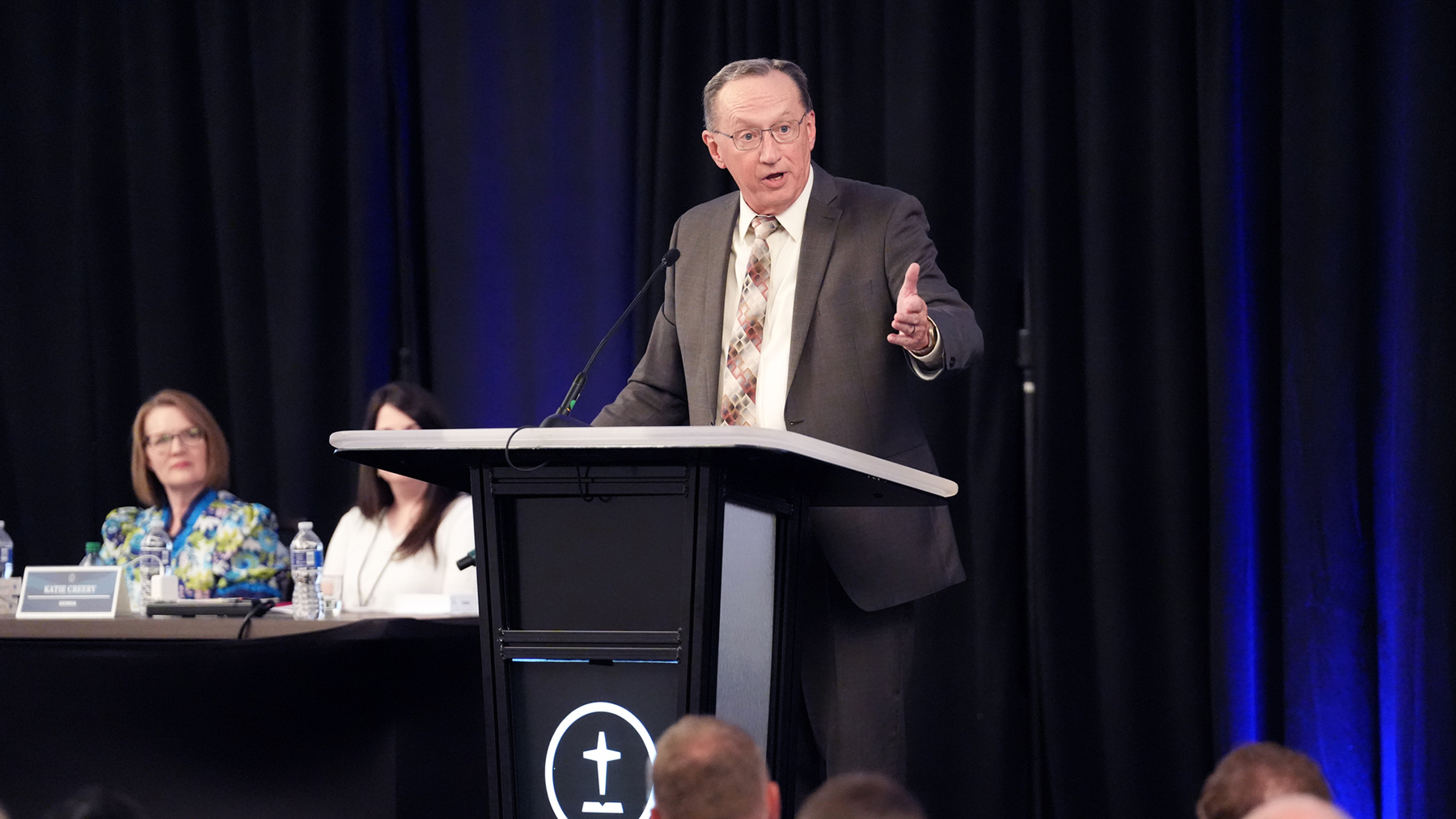
NASHVILLE (BP) — The Southern Baptist Convention Executive Committee must concentrate on its “limited but essential function” as it refines its workload under a reduced budget, EC President and CEO Jeff Iorg told the body at its fall 2026 meeting.
“Limited does not mean unimportant,” Iorg said, referencing the EC responsibility to facilitate the work of the SBC and its entities. “While that is an important role, it is a limited role and is designed to be a behind-the-scenes role.
“We are at our best at the Executive Committee when we facilitate the success of others. Our work should be done without notoriety or unnecessary controversy,” Iorg said Sept. 21 in his presidential address to the EC. “That’s our goal as we refine our workload to fit the available resources and stay focused on our core mission in the future.”
Iorg spoke ahead of the EC’s anticipated adoption Sept. 22 of the SBC and EC operating budgets expected to reflect a 12 percent reduction, $660,000, for the EC.
“This was our contribution as the Executive Committee for the overall goal of increasing the IMB (International Mission Board) CP allocation to 51 percent,” Iorg said. “To balance our budget next year, we have reduced compensation and benefits. We have curtailed ministry efforts, increased fees for services, and implemented new efficiencies in several areas.”
Iorg prepared the EC for several proposed changes reflected in the budget following the EC’s evaluation of its role, functions and governing documents on the road to streamlined but efficient operations.
“Clearly, multiple actions by the convention over the past several years mandate we reconsider the scope and methods of our work,” Iorg said. “Changes requiring convention decision will be shaped over the next few months and finalized in February 2027 for presentation to the convention as needed in June 2027.”
Other priorities Iorg addressed included the Truth and Unity Amendment to the SBC Constitution that received in June the first of two consecutive messenger approvals required for passage. The proposal would amend Article III of the constitution to state that a cooperating church “does not act to affirm, appoint, or endorse a woman serving in the office or function of a pastor/elder/overseer, specifically preaching to the assembled congregation.”
As the EC would be responsible for implementing the amendment, Iorg stressed the importance of the EC’s as well as churches’ understanding the qualifications the amendment would create if adopted and how it will be applied. To that end, he encouraged the EC to await the report of a special commission SBC President Willy Rice has appointed to provide guidance on the amendment’s meaning and application.
“Rather than make premature conclusions, our best response is to cooperate with President Rice and his plans to address the concerns people have about the amendment,” Iorg said. “Let’s allow the Commission to do its work, communicate with them as appropriate, and then respond to their actual proposals rather than speculations.”
Among pending business items facing the EC, Iorg briefed members on a new Internal Revenue Service policy. Revenue Procedure 2026-8 revises requirements for group tax exemptions, impacting the exemption the EC has held since 1964 on behalf of Southern Baptist churches and entities.
“The terminology in the new IRS policy and forms is problematic for the SBC at several points related to our polity – particularly issues related to autonomy and ecclesiology.” Iorg said. “We have been working earnestly to make a good faith effort to comply with the new rules.”
The EC’s legal team and independent auditors have met multiple times with IRS representatives, peers from other religious groups and EC staff in addressing the issues arising from the new rules, creating an internal position paper for the EC’s approval this calendar year.
“This kind of legal, financial and theological processing of a complex decision is a good example of why the SBC created and needs an Executive Committee,” Iorg said. “This, in short, is what we do.”
In other updates, Iorg briefed the EC on legal matters related to lawsuits in which the EC is named as a defendant; the Fortify Initiative training model Baptist associations can use to train churches in sexual abuse prevention and response, and the clarification of the EC as a committee, not an entity.
He expressed appreciation for Southern Baptists in continuing to support the denomination’s mission and ministries.
“We are a force for good, despite our shortcomings. We are making an eternal difference around the world. We are working in countless communities in dozens of countries and across the continents,” he said. “We’re sharing the Gospel, planting churches, meeting human needs and educating future generations.
“Tonight, we have chaplains on warships in the Middle East. We have workers caring for disaster victims in Nepal. We have professors helping sustain seminaries in Ukraine, and missionaries planting churches in dangerous places we cannot even say.”
Iorg reiterated SBC President Willie Rice’s clarion call to fulfill the Great Commission.
“May we never lose sight of that” Iorg said, “as the reason we are here in the first place.”



Comments are closed.