
BRENTWOOD, Tenn. — The courts may still be deciding the legal status of political endorsements in churches, but most pastors have already made their decision.
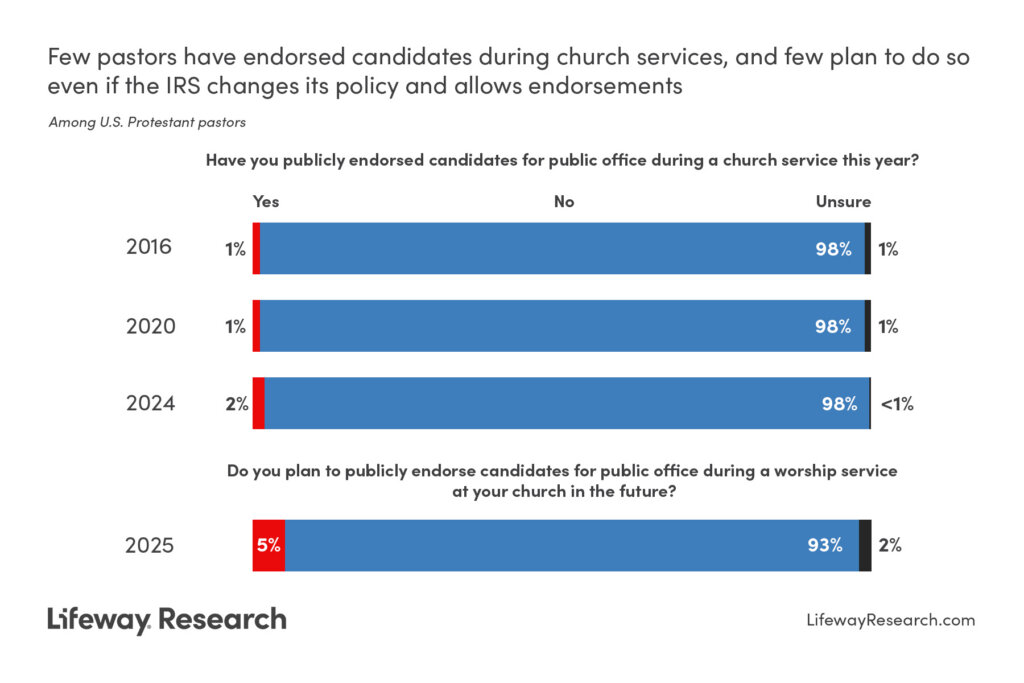
A Lifeway Research study found 93 percent of U.S. Protestant pastors say they don’t plan to endorse candidates for public office during a worship service, despite the IRS saying it will allow churches to do so without losing their tax-exempt status.
“Since historically very few Protestant pastors had endorsed candidates from the pulpit, we were interested in whether the IRS ruling last year would change that,” said Scott McConnell, executive director of Lifeway Research. “Were pastors simply obeying the tax law or was their neutrality in a worship setting their conviction?”
Legal confusion
Beginning in 1954, the U.S. tax code prohibited tax-exempt charitable organizations, including churches, from endorsing or opposing political candidates. Since the passage of this provision, known as the Johnson Amendment after then-Sen. Lyndon B. Johnson, churches have risked losing their tax-exempt status when they engage in political acts such as contributing to political campaigns or making public statements in favor of or in opposition to specific candidates.
In 2024, the National Religious Broadcasters (NRB), two Texas churches and another religious nonprofit sued the IRS over the rule, claiming it violated their First Amendment rights to freedom of speech and freedom of religion.
Those parties reached a settlement in 2025 with the IRS changing its 70-year precedent and allowing churches to endorse political candidates in their “usual channels of communication” without risking tax-related consequences.
However, a district court judge’s ruling in March rejected the settlement. Judge J. Campbell Barker in the U.S. District Court for the Eastern District of Texas dismissed the lawsuit. Barker ruled that federal courts do not have the jurisdiction to change the tax status of a plaintiff or create tax law exemptions.
The plantiffs appealed the decision to the 5th U.S. Circuit Court of Appeals, which has yet to rule.
As part of that appeal, the U.S. Justice Department submitted a brief in favor of the settlement and urging the appeals court to reverse the ruling.
However, even if everything were legally settled to allow religious organizations to endorse candidates, few pastors would take that opportunity.
Church certainty

Responding after the IRS announced its policy change but before Judge Barker rejected the settlement, pastors affirmed their long-standing avoidance of political endorsements from the pulpit.
Only 5 percent of U.S. Protestant pastors say they plan to publicly endorse candidates during a worship service at their church, while 93 percent say no and 2 percent aren’t sure.
While few pastors plan to make such endorsements, some are more likely than others. African American pastors (11 percent) and pastors of other ethnicities (9 percent) are more likely to make endorsements than white pastors (4 percent). White pastors are the most likely to say they do not plan to publicly endorse candidates (94 percent).
Pastors in the South are more likely than pastors in the Midwest to say yes to endorsing candidates (7 percent v. 3 percent). Pastors without a college degree are more likely to say yes than those with a master’s degree (8 percent v. 3 percent). Pastors with a master’s degree are the most likely to say no (96 percent).
Denominationally, Pentecostal (13 percent), Baptist (9 percent), Holiness (7 percent) and non-denominational (7 percent) pastors are more likely than Lutherans (1 percent) and Methodists (1 percent) to say they plan to endorse a candidate.
“In a government run by representatives elected by the people, elections are a key form of civic involvement for Christians,” said McConnell. “Pastors teach regularly on topics that can be part of voting decisions such as moral standards, justice and priorities. Yet few church traditions have more than a few percent of pastors planning to endorse specific candidates if it is permitted.”
Pastors have been consistently opposed to political endorsements from the pulpit for the past decade. In the past three presidential cycles, according to Lifeway Research, few pastors endorsed a candidate during a church service — 2 percent in 2024, 1 percent in 2020 and 1 percent in 2016.
Americans, meanwhile, have grown more accepting of direct political involvement from pastors. The share of Americans who believe it is appropriate for pastors to endorse candidates during a church service has steadily climbed. In a 2008 Lifeway Research study, 13 percent believed this was acceptable. That grew to 19 percent in 2015. Online surveys showed higher levels of acceptance at 24 percent in 2020 and 29 percent in 2024.
If the public wants to know a pastor’s political opinions, they’re more likely to hear them when pastors step away from the pulpit. In 2024, 25 percent of U.S. Protestant pastors said they had endorsed a candidate outside of their church role that year.
“However the legal arguments on the Johnson Amendment are settled, it may have very little impact on candidate endorsements from churches,” said McConnell. “If the IRS ultimately allows candidates to be endorsed in church services, 93 percent of pastors will not do so. What pastors say from the pulpit has far more to do with their religious convictions than avoiding tax penalties.”
For more information, view the complete report and visit LifewayResearch.com.
Methodology
The phone survey of 1,003 Protestant pastors was conducted Sept. 2-24, 2025. The calling list was a stratified random sample, drawn from a list of all Protestant churches. Quotas were used for church size. Each interview was conducted with the senior pastor, minister or priest at the church. Responses were weighted by region and church size to more accurately reflect the population. The completed sample is 1,003 surveys. The sample provides 95 percent confidence that the sampling error does not exceed plus or minus 3.3 percent. This margin of error accounts for the effect of weighting. Margins of error are higher in subgroups.



Comments are closed.