
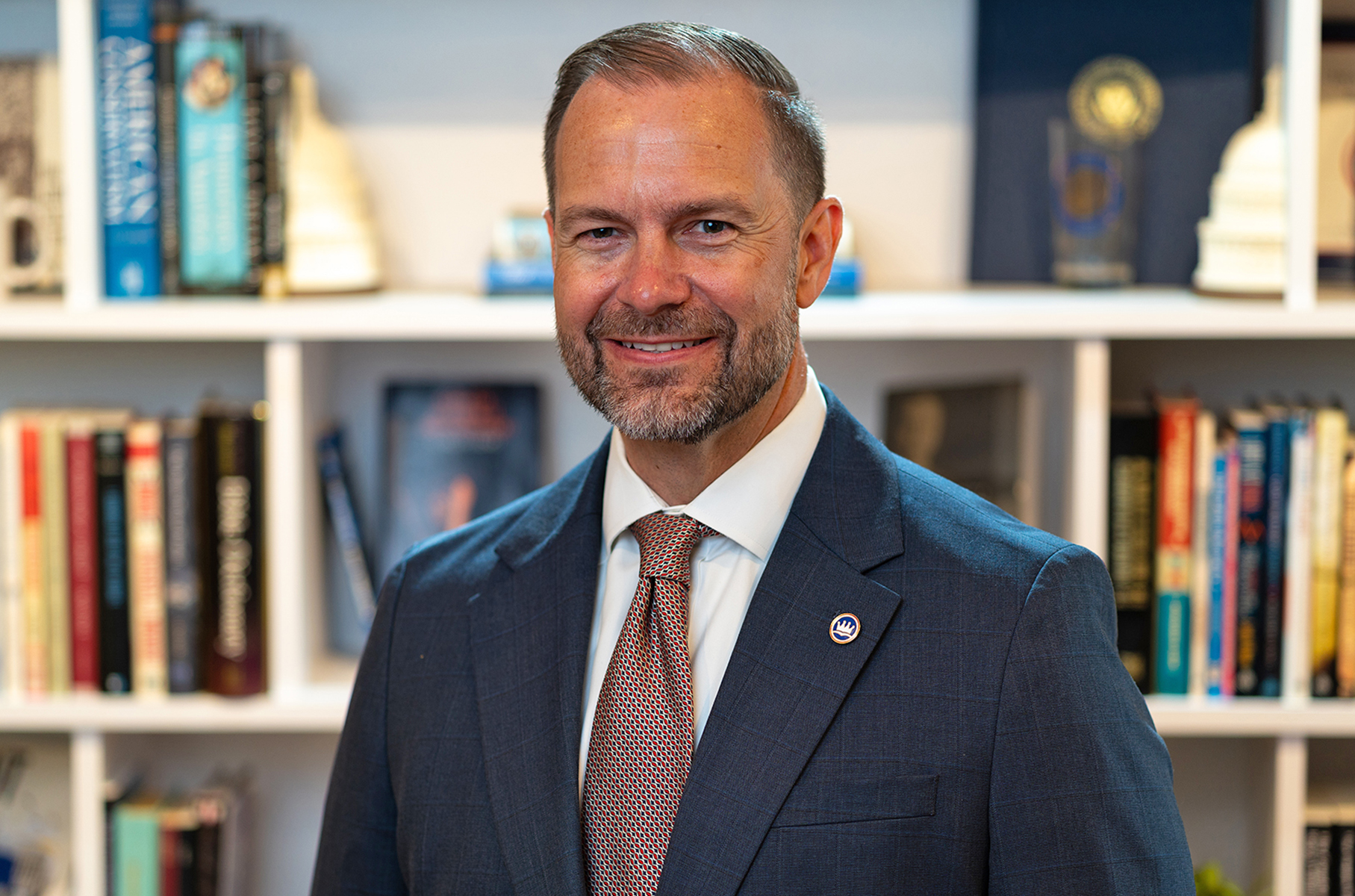
The Baptist Record (BR): We were told by Zach DePriest (Mississippi Baptist Convention Board Student Ministries Consultant) this was a must-ask — have you tracked down the nearest Whataburger to the Ethics & Religious Liberties Commission (ERLC) headquarters in Nashville yet?
Dr. Evan Lenow (EL): Clearly, Zach DePriest is concerned about my culinary well-being. Having Whataburger in the Nashville area was a condition for me even thinking about the job. Rest assured that I have successfully located the nearest Whataburger to the SBC building in East Nashville. It’s a short 13-minute drive from the office in a great part of the city with a good restaurant scene.
BR: Having spent time teaching at Mississippi Christian University, what did you come to appreciate most about Mississippi Baptists?
EL: Mississippi Baptists are one big family. No matter where I went, it did not take very long to make connections and figure out mutual friends. Once relationships are established, then you are always part of the family. I feel like I will always be part of Mississippi Baptists, and I look forward to spending time in the churches of the state long after I move.
BR: What motivated you to say “yes” to serving as president of the ERLC?
EL: I first became aware of the work of the ERLC as a seminary student more than 25 years ago. Through the years, I have always appreciated the work of this entity as a resource to both train Southern Baptist churches regarding moral concerns and advocating on behalf of Southern Baptists related to public policy. I now believe that the work of the ERLC is more important than ever.
It is also a humbling experience to be asked to serve Southern Baptists. I grew up in a Southern Baptist church. I was educated in Southern Baptist schools, including Mississippi College (now Mississippi Christian University). God used these experiences to grow me into who I am today, both personally and professionally. Southern Baptists taught me a love for the local church and commitment to stand on God’s unchanging Word.
I believe in the mission and ministry of the ERLC. It is needed more than ever in today’s complex and confusing culture. That is why I was willing to say “yes” to this role.
BR: Many of our readers may not be familiar with the ERLC. How would you describe its mission?
EL: The Ethics and Religious Liberty Commission exists to assist your churches by helping you understand the moral demands of the Gospel, apply Christian principles to moral and social problems and questions of public policy, and to promote religious liberty in cooperation with churches and other Southern Baptist entities. Simply put, that means we provide churches with biblically faithful, practical resources for everyday life and ministry. In addition, we bring the convictions of Southern Baptists to the halls of our nation’s leaders.
BR: From your perspective, how can the ERLC best strengthen its connection with and support of local churches?
EL: The first step is to build relationships and listen. My goal is to spend time with pastors and church leaders, getting to know them, and hearing about the biggest needs they have in their communities. I have been doing this for the last seven years in Mississippi and am excited about expanding this across the entire Convention.
The next step is to provide resources to local churches to address the most difficult questions they face. Over the last several years, the ERLC has produced a number of church guides to assist local church leaders in addressing important moral questions. Recent guides have focused on assisted reproductive technologies, gambling, and gender and sexuality. These guides provide a biblical and theological foundation on a particular topic and then walk through numerous practical scenarios that churches may face. We had several of these guides available at the annual meeting, but all of them can be found on our website to order or to download for free. This is one practical way we are strengthening and fortifying our relationships with local churches.
The third step is to be in the places where Southern Baptists gather. I am excited about state convention season because, along with many of our staff, I will be traveling around to meet pastors and ministry leaders in these states face to face.
BR: We talk a lot about truth, but living it out in today’s culture can be challenging. How does the ERLC help local churches connect moral and ethical living with sharing the Gospel and making disciples in a way that’s lived out day to day?
EL: Ethics is more than just following rules or commands—it is an act of worship. I had the privilege of writing a book with Dr. Mark Liderbach titled “Ethics as Worship,” and the whole premise is found in the title. We approach ethical questions by considering what will maximize the worship of our Creator. In turn, our worship draws people to His saving grace through the power of the Holy Spirit. The questions we face today regarding life, religious liberty, marriage and family, and human dignity are an opportunity to provide answers rooted in the timeless truths of Scripture and point people to their greatest need: salvation through Christ.
BR: Many pastors and church members are navigating cultural pressures and denominational challenges. What encouragement would you offer them as they continue in their work and faithfulness?
EL: My encouragement is for them to remain faithful to the calling God has placed on their lives and remain rooted in their walk with Christ. We also do not walk through these challenges alone. God has given us the Church as the context for sharpening and refining our faith so that we can live faithfully. The Church faces many cultural and societal pressures today, yet this moment offers a profound opportunity to show the watching world the unwavering hope we have in Christ. Jesus teaches in John 15 that He is the true vine and we are the branches. When we remain in Him, He remains in us — and through that abiding relationship, we bear good fruit and weather the cultural storms that come our way.
BR: What are some of the biggest opportunities and challenges the ERLC is navigating right now?
EL: There is an assault on many of the things Southern Baptists care deeply about regarding life, religious liberty, marriage and family, and human dignity. From questions of what it means to be human, to gender and sexuality confusion, to the insidious nature of the abortion industry, we have a lot of work to do, but we are up to the challenge.
BR: The ERLC has faced some criticism in the past. How would you reassure churches that it is not only a vital part of the Southern Baptist Convention, but that it should also continue to be supported through the Cooperative Program?
EL: I believe that the ERLC is more relevant today than ever. The cultural tides on matters of ethics are shifting faster than in times past, and churches are faced with questions of ever-increasing difficulty. The SBC needs the ERLC more now in these deeply complex times to do the very things the Convention has entrusted to this entity. The Cooperative Program is a tool for Southern Baptists to do more together than we could ever do separately. In order to continue resourcing churches to face the difficult moral challenges in their own communities, the ERLC depends on CP support. Southern Baptists are at our best when we cooperate together for the sake of the Great Commission. But we also cooperate together through the ERLC to aid one another in addressing moral issues and in having a unified, effective voice in the public square — all for the sake of our witness in this world.
BR: Dr. Iorg, president of the SBC Executive Committee, has often described the Southern Baptist Convention as “a force for good.” What do you see as the driving force behind the ERLC’s work within that mission?
EL: There is no group of believers like the Southern Baptist Convention. Our most recent annual meeting was a clear reminder to me that we have a wonderful family of churches that make up our Convention. We can do more by working hand in hand. Ultimately, our driving force is the same as every other entity and church: to make Christ known across the street and around the world.
BR: How can Mississippi Baptists specifically be praying for you and your work in this new role?
EL: I would like to ask Mississippi Baptists to pray for the work God has called us to do. Pray for discernment, wisdom, grace for each day, and for the Gospel to go forth throughout the culture. Pray for my family as we continue the transition into this new role.




Comments are closed.