

Real Devotion • Matthew 15:1-11,16-20
By Joe McKeever
Before looking at the lesson, I always suggest we stop and read the text. Matthew 15:1-11 and 15:16-20.
Think of the Christian life as a coin. One side is marked “Real Devotion,” by which we mean heart-felt dedication and love-motivated righteousness. The other side wears many names, chief among them Hypocrite! The hypocrite is an actor, a pretender, a liar.
Let’s look at those two sides.
Deuteronomy 6:5 has been a primary text for God’s people for thousands of years. “You shall love the Lord your God with all your heart and with all your soul and with all your might” (NASB). Nothing in the New Testament changed that. In fact, our Lord quoted it as the Great Commandment (Matthew 22:37).
The problem is the heart. It’s a bear. The prophet said it is deceitful above all things and desperately wicked (Jeremiah 17:9).
That’s why our constant prayer is the same as David prayed. “Create in me a clean heart, O God” (Psalm 51:10 NASB).
The problem is hypocrisy.
Now, the essence of hypocrisy is our tendency to say one thing and do another.
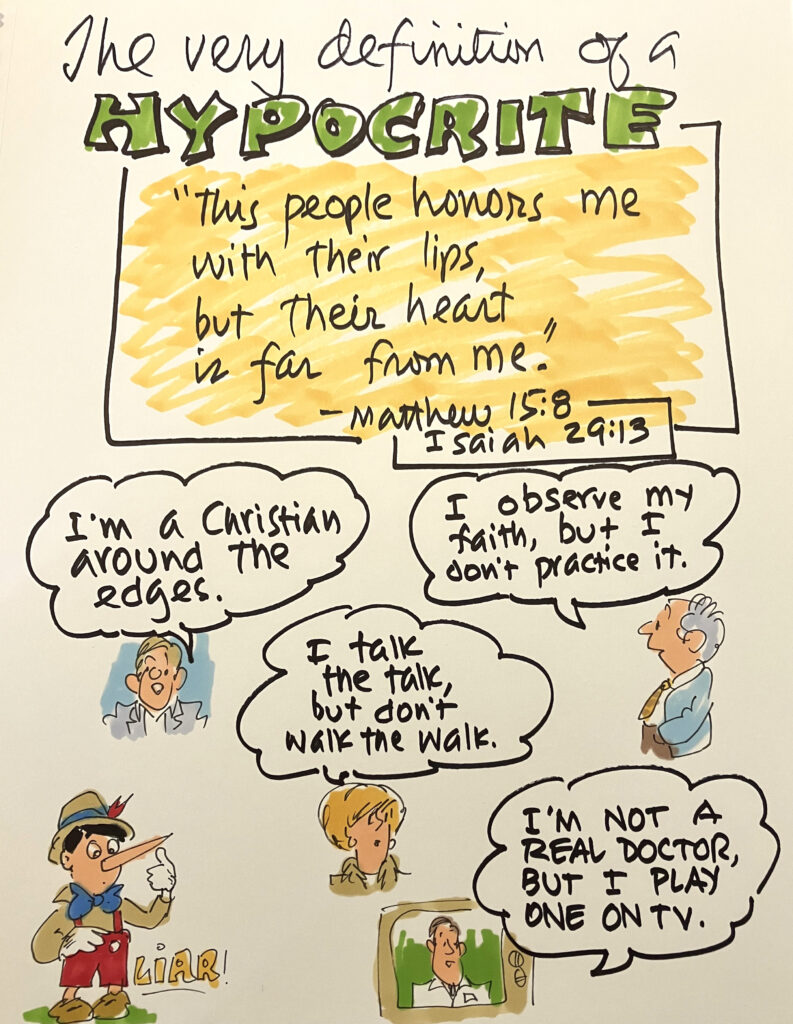
As our Lord said to the religious leaders of His day, “Isaiah pegged you hypocrites exactly right. He said, ‘This people honor me with their lips, but their hearts are far from me!’” (Matthew 15:7-8 my paraphrase)
I once heard a man say he was “Christian around the edges.” That is hypocrisy.
My wife was on the phone with a man who had questions about our church. She said, “Are you a person of faith?” He named his religion, then said, “I observe my faith but I don’t practice it.”
That is hypocrisy.
When the disciples ate without washing their hands, we note they were not accused of breaking God’s laws, but “the tradition of the elders.” Man-made laws. Jesus pointed out these religious leaders were actually nullifying Heaven’s commands to honor one’s father and mother by making it possible to sanctify one’s money so it would not be available for its intended purpose. As a result they ended up dishonoring their parents and disobeying God. This is hypocrisy.
Years ago, a lady — let’s call her Judy — told me of the time she was having coffee with her sister-in-law, a member of a legalistic denomination. When Judy lit up a cigarette, her sister-in-law said, “Did you know that one cigarette will send your soul to hell?”
Judy said, “Really? Explain to me how this one cigarette will send my soul to hell but you can hate your mother — as I’ve heard you say — and still go to heaven?”
The woman had no answer. Legalism never does.
Hypocrisy specializes in self-justification and condemnation of others.
A legalist is someone who says I know God did not say this, but He would have if He’d thought of it.
Scripture has much to say about hypocrisy. In our Lord’s sermon to the Pharisees, He calls them by that name seven times (Matthew 23). We note that hypocrites were almost always religious people, but they never got it right. Their profession and their lives did not match up.
We are told that in ancient Greece, actors wore masks to portray the characters they were playing. The word hypokrites came to mean a pretender, one playing a part. “Hypocrite!” was one of our Lord’s harshest words for the religious people of his day.
In our text for this lesson — Matthew 15:1-11,16-20 — two statements from our Lord stand out like mountains peaking through the clouds. The quote from Isaiah 29:13 describes the essence of hypocrisy.
The other mountain peak is the parable in 15:11, which is explained in 15:16-20. This is the essence of spiritual defilement. It’s not what goes in, our Lord said, but what comes out!
This “parable” (so-called by Peter in 15:15) does not rank among the most familiar parables of our Lord. I suspect that’s because it’s counterintuitive, meaning “it doesn’t seem like it should be true but it is.”
Just this week we heard of a gunman killing people at an Austin, Texas, night club. By all reports, it was a “hate crime.” The man wore messages on his clothing that identified him as a terrorist. The man definitely needed something our Lord could give him: a new heart.
We church-goers must always be on guard against the tendency to say one thing and do another, to talk big and act little.
Every day of our lives we should pray, “Father, purify my heart. May I be pleasing to Thee in all I do and say.”
McKeever is a member of First Baptist Church, Jackson.



Comments are closed.