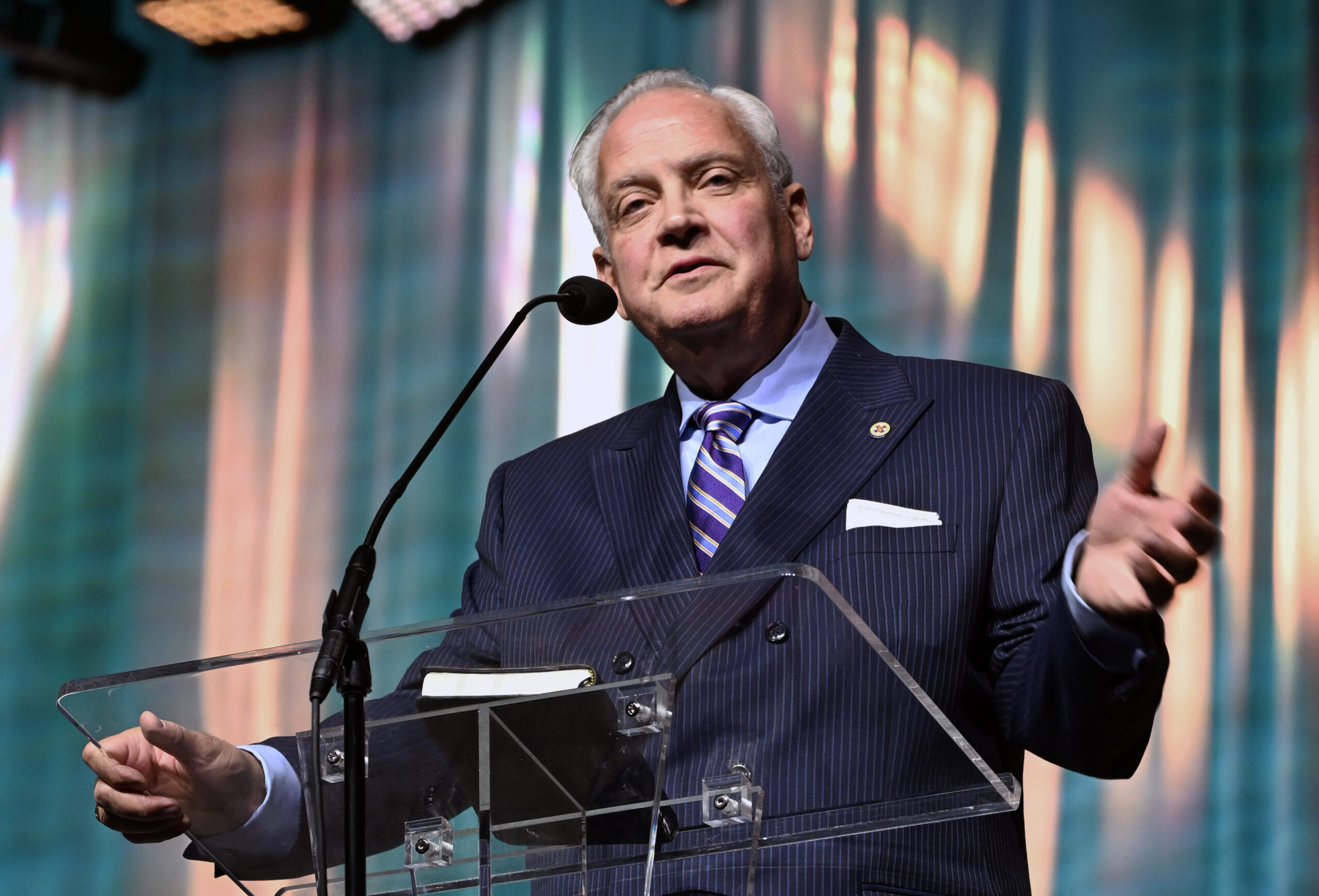
LOUISVILLE, KY. (BP) — “I think I blew it,” Albert Mohler responded Sept. 14 to critics of his envisioned blasphemy laws under a hypothetical Christian nationalism supposed in a book chapter he wrote.
Mohler’s comments in the 2026 book “Five Views on Christian Nationalism,” which proved contentious, were based on the supposition of drafting a new constitution for a fractured nation in the year 2099.
Mohler, president of Southern Baptist Theological Seminary, argued that the nation’s constitution should acknowledge its foundation on Christianity encompassing the Holy Trinity, that citizens should be required to acknowledge such a Christian foundation, and that blasphemy should be criminalized as “a fundamental rejection or repudiation” of the republic’s foundation.
He is among five authors offering varying scenarios in the book from Canon Press, and he participated in a related webinar Aug. 7.
In today’s column, Mohler recanted his August comments regarding blasphemy. He maintains his premise that the U.S. Constitution erred in not acknowledging the nation’s Christian foundation, as well as his proposal that citizenship and public office should require substantial acknowledgement of that foundation.
“In the book, based in a hypothetical situation, I argued for blasphemy laws to be effectively redefined in the context of constitutional acknowledgement. On this score, to state the matter plainly, I think I blew it,” Mohler wrote, thanking his critics for their input. “The setup for the book was a bit awkward for me, since it asked the contributors to respond to a hypothetical future scenario in which the United States has failed and small regional nations have emerged. I have never responded to any similar context, and one effect of a hypothetical is that a writer is allowed some freedom to address issues that otherwise might be conscribed by the present order of things. I am not built to address hypotheticals like this.”
Mohler erred in using “an old word (blasphemy) in a new context,” he wrote in WORLD. “In the larger sense, I should have just stated that doctrinal and theological judgments are matters for the believing church and left the government out of it. It is a complex and complicated question when seen in the span of Christian history and constitutional development.
“But Baptists have been on the wrong side of the lash and the law throughout our history and have learned to separate the roles of church government,” Mohler wrote. “I was not calling for conventional blasphemy laws, and I have never advocated or supported any such legislation. I have supported religious liberty for all citizens energetically and forcefully. Needless to say, I fully support our current constitutional order. That is not in question.”
Among Mohler’s critics is Richard Land, former president of the Southern Baptist Ethics & Religious Liberty Commission, who served with Mohler on the committee that led to the 2000 version of the Baptist Faith and Message (BFM). Land deemed Mohler’s requirement for citizens to acknowledge the nation’s Christian foundation as contrary to Article 17 of the BFM upholding religious liberty.
“When Mohler advocates that officeholders make ‘public and authentic acknowledgment of the nation’s formal commitment to the God of the Bible, specifically the Holy Trinity,’ and ‘an acknowledgement of the binding moral authority of the Bible, including both the Old and New Testaments,’ how is this not a ‘religious test’ for political office by any other means?” Land wrote Sept. 4 in The Christian Post. “For example, Thomas Jefferson, a Unitarian, would be disqualified from holding office, much less being president.
“While I would prefer all officeholders to meet at least Mohler’s guidelines,” Land wrote, “the only Baptist and constitutional way to do that is by electing them to office, not disqualifying those who do not meet these spiritual standards.”
Mohler yet disagrees with Land’s deduction, acknowledging him as a “dear friend.”
“My purpose is to make clear that, as a Baptist, I would never want to coerce religious belief – period. The concept of acknowledgment would not bar Thomas Jefferson or any other president from the White House, since it is not a test of personal religious beliefs,” Mohler clarified. “I stand by my argument on acknowledgement, though it is at this point in history, in the real world, not a matter of political possibility. It is, I think, a fruitful tool for thinking through the issue.”
Mohler’s now recanted description of blasphemy is contrary to his comments 15 years ago here, when he described blasphemy laws as contrary to Christianity.
“Anti-blasphemy laws serve the honor logic of Islam but not the evangelistic aims of Christianity,” he wrote in 2011. “It is wrong to give governments the power of theological coercion. Seen in this light, blasphemy is no small matter, but anti-blasphemy laws are deadly barriers to the proclamation of the Gospel.”
Read Baptist Press’ previous story here, and Mohler’s WORLD response to criticism here.