
By Lindsey Carraway
Writing Specialist
One Royal Ambassadors leader and a few coffee cans was all it took to construct a makeshift feeding kitchen for the victims of Hurricane Beulah in 1967. With his homemade ‘buddy burners,’ made of 10-gallon cans turned into stoves, Bob Dixon and Texas Baptist Men prepared hot meals for the survivors and truck drivers delivering aid in the Rio Grande Valley.
Dixon’s inventive, intentional effort to overcome the obstacles and serve disaster victims sparked a movement. By 1976, four more state conventions followed Texas — Mississippi, Oklahoma, Louisiana, and Kansas/Nebraska — and acquired their own mobile feeding units, laying the foundation for what would become Southern Baptist Disaster Relief.
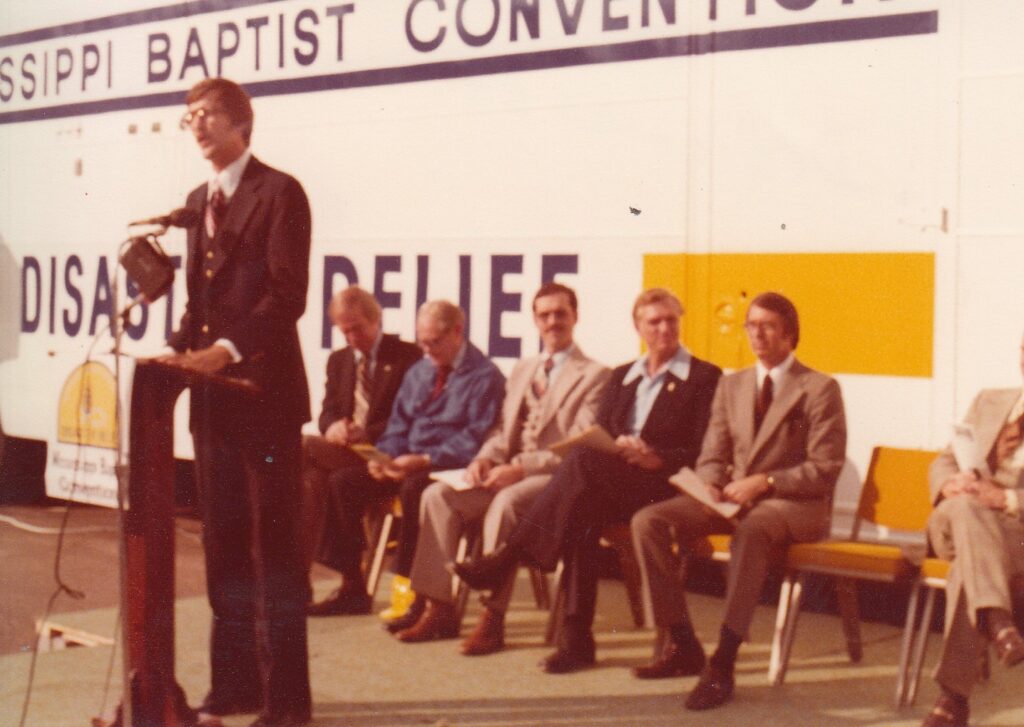
For fifty years, Mississippi Baptist Disaster Relief (MSBDR) volunteers have hurried help to helpless places: food to the hungry, water to the thirsty, and a path forward in the aftermath of devastation. They have brought hope where there was no hope: a listening ear, a lifted prayer, and a love unlike anything in this world. They have offered healing to the scarred and stranded stranger: restoring what was destroyed, salvaging what was ravaged, and most of all, shedding eternal light into the darkest days of people’s lives through the transformative, life-giving truth of the Gospel of Jesus Christ.
We mention only a few of the hundreds of volunteers who have answered the call to reach into the ruins of destruction and deliver aid to distressed survivors. These volunteers likely take a pew near you every week, dressed in their Sunday best, with a yellow uniform waiting ready in the closet back home.
Only a few disasters of the past fifty years take up these pages, but the tragedies in between, which shook the foundations and swept away the frameworks of normalcy for so many people, are by no means forgotten.
Paul Harrell: Good and faithful servant
Under the humble leadership of Paul Harrell, Mississippi Baptist Convention Board (MBCB) Brotherhood Director from 1977-2001, the MSBDR “grew into one of the nation’s most respected disaster response organizations.”
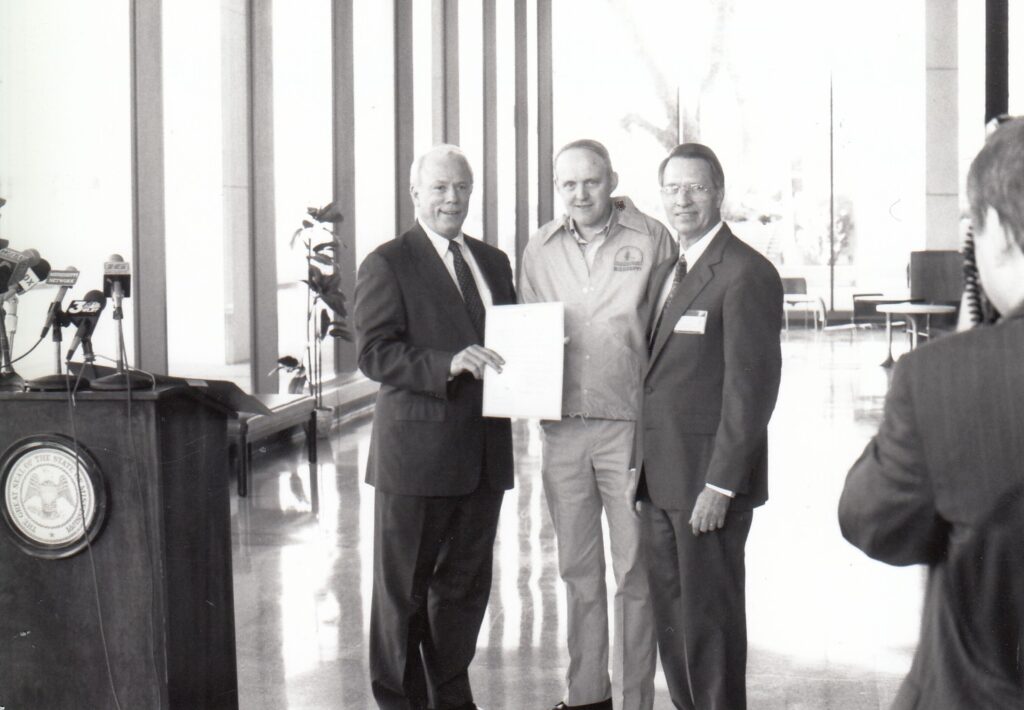
Harrell, who went on to be with his Lord and Savior July 2 at 90 years of age, set an example for the Christ-like compassion that MSBDR volunteers have provided for decades. His obituary reads, “His legacy lives on in his devotion to his family, the countless lives he touched, the churches he strengthened, and the disaster relief ministry that continues to bring hope and help to people in times of greatest need.
“While he will be deeply missed by those who knew and loved him, they rejoice in the assurance that he is now in the presence of his Savior, hearing the words, ‘Well done, good and faithful servant.’”
In honor of his legacy, memorials were made to the Mississippi Baptist Disaster Relief.
First deployments
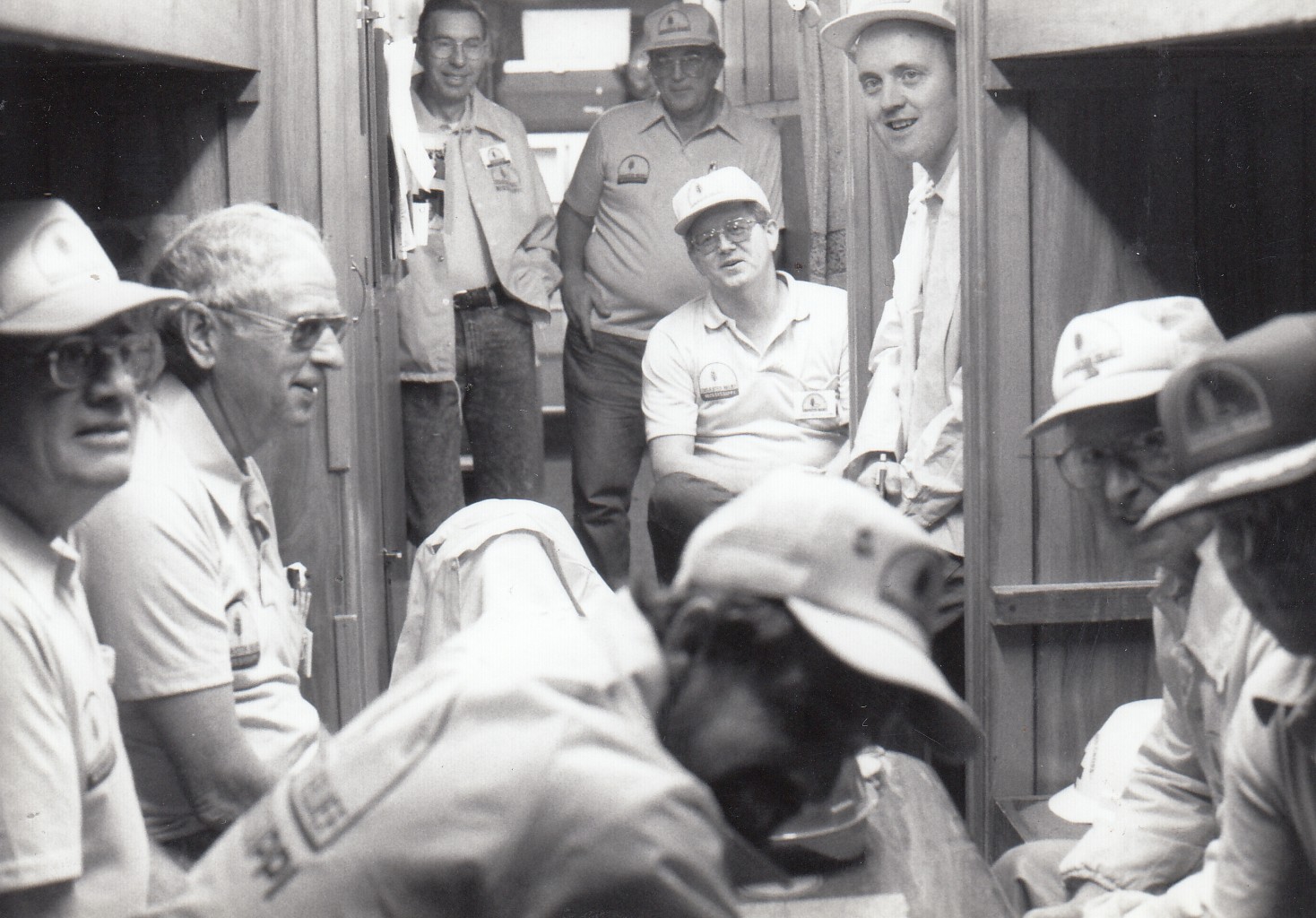
In April 1978, MSBDR volunteers received their first call to action when a tornado tore a destructive path through parts in and around Utica, causing extensive structural damage. With hard hats ready, the volunteers offered comfort and cleanup to the families and local businesses affected by the storm.
When Mexico City was struck by a violent 8.0 magnitude earthquake followed by an aftershock of 7.5 magnitude in September of 1985, killing 5,000 people and collapsing hundreds of buildings, Southern Baptist disaster relief crews set out to respond with food, supplies, and spiritual care. As the first international response for MSBDR volunteers, and one marked by a devastating death toll, the operation proved to be unforgettable.
The Mississippi team worked alongside Mexican Baptists to manage a mass feeding kitchen to victims now homeless and jobless. Many survivors searched for missing loved ones through heaps of rubble. In the wake of their ruin, however, the Mexican people were overwhelmingly grateful for the help and wide open to the Gospel.
By October, the SBC relief units had reported 2,000 professions of faith. New churches were taking root amid the wreckage. Jim Didlake, MSBDR onsite coordinator and staff member of the MBCB Brotherhood department, recounted how numbers of people would come up to the unit, asking volunteers to tell them about Jesus. A warm relationship developed between the Mississippi team and the people of Mexico City “almost instantaneously.”
National heartbreak, eternal hope
“Where were you when it happened?” Twenty-five years later, millions of adults still recall in detail the moments following the attacks of Sept. 11, 2001.
Within days of the traumatic tragedy, six top personnel of the MSBDR Task Force arrived in New York and Washington D.C. to feed first responders and provide trained chaplaincy care to the hundreds of grieving families and workers at Ground Zero. “What you see on TV didn’t do justice to the damage,” Didlake remarked to The Baptist Record.
For two weeks, members of the Task Force set up on the parking lot of the Pentagon, just 100 yards from the crash site, to prepare 4,000 meals per day and provide counseling to the staff. Other Task Force members walked 15-20 miles each day just to offer a listening ear to passersby.
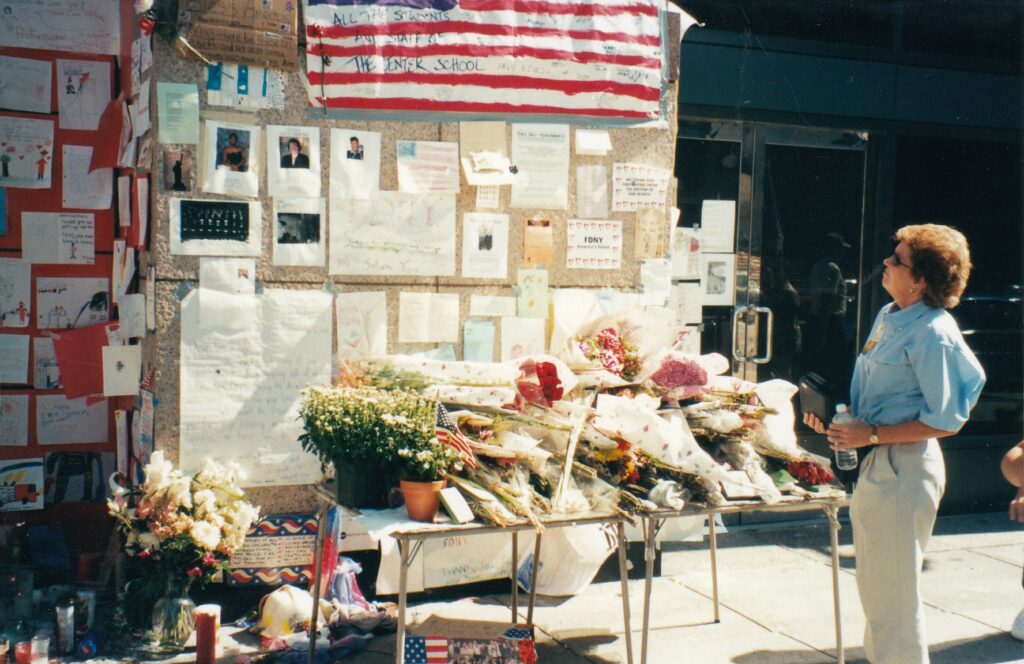
“People wanted to tell their stories,” said Kay Cassibry, Task Force chaplain and executive director of the Mississippi Woman’s Missionary Union at the time. “They wanted to tell you where they were when it happened. They wanted to tell you who they knew, what they thought about it, how they felt about it — if they could find the words to describe it.”
After the six returned, 15 more members of the MSBDR Task Force sacrificed their Thanksgiving week to feed the thousands of first responders still seeing to the ongoing relief. Mississippi disaster relief volunteers also actively and sensitively tended to the needs of New York City as counselors, as comprehensive apartment cleaners, and as child caretakers.
Back home, Mississippi Baptists continued to send thousands of dollars to victims and established a ministry primarily aimed at encouraging one police precinct who had lost a large number of colleagues in the attack. Cassibry, who took three separate disaster relief trips, as did Didlake, spoke for all Mississippi Baptists when she commented, “We definitely lost our hearts to New York.”
Apocalyptic aftermath
On Aug. 29, 2005, a wasteland across the Southeastern states was left behind by Hurricane Katrina. A day after landfall, MSBDR volunteers showed up as the first responders on the Gulf Coast and set up the massive mobile unit on the parking lot of First Baptist Church, Biloxi. With no electricity nor potable water at the start, and with humid, summer temperatures swelling into the 90s, volunteers worked around the clock just to feed wandering survivors.
Bobby Welch, SBC president at the time, said to The Baptist Record about the storm-ravaged Gulf Coast, “Despite the best efforts of the news media, it’s impossible to sense the confusion, observe the destruction, smell the stench, hear the cries, dry the tears, clothe the threadbare, as well as hug and feed the hurting and hungry unless you’re here. This is a disaster of biblical proportion, and it demands a biblical response — now.”
Soon the entire brigade of Southern Baptist disaster relief units were working across the scope of the storm’s leveling path. In Mississippi alone, over 305 people had lost their lives or remained missing, and billions of dollars’ worth of homes, businesses, churches, transportation, and infrastructure had washed away.
Trained MSBDR chainsaw crews, childcare workers, cleanup groups, and medical teams ministered to the victims who sifted through the pieces of their past with only the clothes on their back. Volunteers on the mass feeding unit, a fully self-contained 18-wheeler, prepared 12,000 meals per day, an added 2,000 meals to the unit’s intended capacity. Meanwhile, Mississippi Baptists all over the state continued to donate and distribute tons of foods and supplies for relief.
As reported in Nov. 2005, more than 9,000 SBC volunteers from 41 state conventions responded to the disaster. SBC disaster relief units had prepared a record 10.5 million meals since Hurricane Katrina made landfall, with the MSBDR Task Force having served a sizeable amount of the total meals. Gifts to the MSBDR fund, as of that November, totaled more than $10 million.
Reporting throughout the months of recovery, William H. Perkins, Jr., editor of The Baptist Record at the time, commended, “While people from across the nation are seeking to help us, the most amazing thing is to see Mississippi Baptists, some of whom are victims themselves, reaching out to others to bring hope and help.”
Recent years
While compassion leads the way, MSBDR applies Christ-like strategy to every situation. In 2020, as a response to the challenges of COVID-19, volunteers adapted quickly to retrain for the added protocols, reconfigure feeding operations for contactless service, and navigate travel restrictions and health mandates.
The widespread devastation of Hurricane Helene in 2024, the multiple, violent tornadoes in 2025, and the thousands of other storms and floods that have raged and claimed lives in only the last few years, all tell stories where volunteers have entered devastated scenes to share the help, hope, and healing of the Gospel through hard-working hands and servants’ hearts.
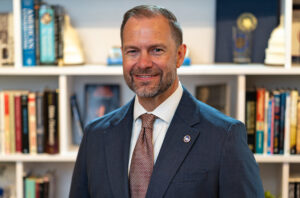
“The story of the past fifty years reminds us that when we prepare well, serve intentionally, and work together, our ministry reaches farther and our witness shines brighter,” said current MSBDR director Hubert Yates. “The next chapter of MSBDR will be written by volunteers, churches, and associations who understand that every act of service is an opportunity to glorify Christ. And as Mississippi Baptists continue to stand side by side, the ministry of Disaster Relief will remain what it has always been — a living testimony to the Gospel we proclaim.
“As we look to the future, the legacy handed to us calls for a broader, more intentional vision. We envision every Mississippi Baptist congregation engaged in local disaster ministry, meeting needs in their own communities with readiness, excellence, and compassion. We see the strengthening of the cooperative ties that have defined MSBDR from the beginning, enabling us to respond to larger events and greater needs. We see Mississippi Baptists joined together through common mission — trained, prepared, and moving in compassion when Mississippi calls. And we see Mississippi Baptists stepping into national and international deployments, carrying Christ’s compassion to places far beyond our borders.
Your gifts to the Cooperative Program support Mississippi Baptist Disaster Relief efforts. For more information contact Hubert Yates at hyates@mbcb.org.


Comments are closed.